
The boxers hardly broke a sweat while scooping all the seven gold medals up for grabs, while the shooters ended their campaign with an outstanding tally of 25 gold medals to ensure India's reign at the top remained unchecked in the 12th South Asian Games in Guwahati on Monday. On the penultimate day of competition, the Indian was perched at the top with 289 medals (173 gold, 86 silver and 30 bronze).

Switzerland has been named the happiest country in the world.

'A collapsing Pakistan may well unleash its nuclear weapons as the last throw of the dice. With a nuclear arsenal of over 50 bombs, even a regional nuclear exchange can devastate the world.'
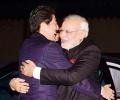
'The regional context and the personal ties between Modi and Japanese Prime Minister Shinzo Abe to a large extent contributed to this dawn of a new era in bilateral relations,' says Srikanth Kondapalli.

'Parents would do well by the nation if they were to persuade their sons and daughters not to become puppets in the hands of the Islamists,' feels Lieutenant General Ashok Joshi (retd).

After weighing all the costs and benefits, the next administration is likely to reduce and restructure assistance to Pakistan but not to end it altogether, says Daniel S Markey.

'India-US relations seem to have soured when the US expected India to not only balance China in the Asia-Pacific, but also make concessions to Pakistan as a price for US technological help,' says Colonel Anil A Athale (retd).
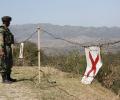
'The response to terror is not always reciprocal terror, nor is launching a conventional response the best response.' 'The best response is to make the sponsor pay a price he cannot afford,' says former RA&W chief Vikram Sood.

8,000 asylum-seekers reach Germany in a single day amid deepening refugee crisis

With Pakistan's powerful army chief Gen Ashfaq Parvez Kayani's term coming to an end in November, names of top generals who are likely to succeed him are being discussed in the political circles and in the corridors of power.

'Pakistan persists in the belief that such attacks will enable it to obtain the territory it covets. Their plans will not succeed.'

United States President Barack Obama has authorised "targeted air strikes" against Islamic militants to protect American military personnel and airdrops of meals and water to thousands of religious minorities trapped on a mountaintop in northwest Iraq.

New Delhi remains a priggish suitor to Washington's overtures, but it has begun appreciating potential tech benefits to ties with the US.

Building relations in the Indian Ocean, New Delhi has gifted naval vessels to Mauritius, the Maldives and Sri Lanka, even as China eyes the same locales.

How many of the 354 films Aseem Chhabra watched in 2017 have you seen?

"We should make it clear to Pakistan that any LeT attack upon our homeland, they will bear responsibility for that because of their close relationship between ISI and LeT," Congressman Peter King said during a Congressional hearing on Wednesday.

Even as the United States snuggles closer to India with the thinly veiled objective of containing China, the Indian strategy is to avoid alienating either nation.
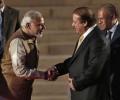
Prime Minister Narendra Modi's real test will be whether he can bring a longer-term vision to India's foreign policy planning, says Ravi Agrawal.

Pakistan's hawkish Army chief Gen Ashfaq Parvez Kayani, who did little to change the force's India-centric stance, will leave the world's sixth-largest army grappling with a host of security challenges when he steps down on Friday.

The India card is now almost obsolete. There are more pressing challenges. People of Pakistan are fed up with years of bad governance, corruption and broken promises of successive governments. However, the politicians and former generals are still provoking sentiments on what is happening on the Line of Control for petty political gains, says Shahzad Raza.

The United States has carried out "unlawful killings" in Pakistan through drone attacks, some of which could even amount to war crimes, a human rights group said on Tuesday.

'The creation of Pakistan was integral to Britain's grand strategy.' 'If they were to ever leave India, Britain's military planners had made it clear that they needed to retain a foothold in the NWFP and Baluchistan because that would provide the means to retain control of Iran, Iraq, Kuwait, the UAE, Bahrain and Qatar.'

'If Indian armed forces entered Pakistan and succeeded in inflicting major damage on the Pakistani army and occupied territory in the Pakistani heartland, there is reason to think the Pakistani military would use some nuclear weapons against the incoming Indian forces to compel India to stop.'

From the Syrian civil war to the Ukrainian crisis to the terror unleashed by the dreaded Islamic State, there was no lack of news in 2014. In this five-part series,rediff.com presents a selection of the year's most enduring moments year from around the world.
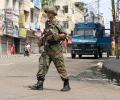
Unfortunately, by presuming guilt of the Army personnel in the Chattergam incident, for what is at worst an honest error, made in good faith, the ability of the military leadership to impose the fighting spirit necessary in their men to curb militancy stands seriously compromised.

A new 7.3-magnitude earthquake and seven powerful aftershocks struck Nepal on Tuesday killing at least 50 people and triggering panic in the Himalayan nation already devastated by a monster temblor less than three weeks ago that had claimed over 8,000 lives.

Six Kashmiri Muslim students belonging to Sarhad, an organisation which brings semi-orphans from strife-torn regions to live and study at their school and college in Pune, share their hopes for their state and their experiences outside it. Jyoti Punwani reports.

At 17, Pakistan's Malala Yousafzai became the youngest Nobel laureate. She was conferred the joint Peace Prize along with India's Kailash Satyarthi at Oslo on Wednesday. Here is the full transcript of her speech.

Read what the ex-chief of R&AW, A S Dulat, told our readers on Rediff Chat!

The two countries also asked all nations to stop cross-border movement of terrorists and asserted that a decisive collective response from the international community without 'double standards and selectivity' was required to combat the threat of terrorism.

'If you invest your entire capital in talks, you cannot abruptly change gear and decide on war.'

Its promise has fallen short before the onslaught of the votaries of the old order and ruthless extremist forces, notes Talmiz Ahmad.

Three Indian Air Force officers captured as Prisoners of War by Pakistan during the '71 War made a daring escape from a Rawalpindi jail. M P Anil Kumar recounts that heroic story.

The Nobel Prize for Malala may have caused deep divisions across the globe and disturbed the peace, while the award to OPCW, though not without critics, may have served the cause of peace by eliminating a weapon of mass destruction from the face of the earth, says Ambassador T P Sreenivasan.

How will the return of a majority government at the Centre, the new India-US friendship and the Mangalyaan triumph change India?
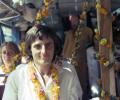
Often when I meet a new Indian friend, who is not aware of my background, he exclaims: "So many years in India! but why, why? I can't understand! My dream is to go to the States or Europe and you are living in 'this' country!" Claude Arpi, who was born a Frenchman, looks back on his 40 years in India.

US Congresswoman Tulsi Gabbard, newly elected co-chair of the influential Congressional Caucus on India and Indian-Americans, discusses her vision for US-India ties with Rediff.com's Monali Sarkar.

'If you destroy the assets in Pathankot, you degrade the combat potential of India; you degrade the war potential of India.'

'It was only relatively recently that Subhash Kapoor was able to secure the sources in India, Afghanistan and Cambodia, that allowed him to get the really highest level objects, and that helped propel him in recent years up the ranks.'

'So a number of people are drawn in along with members of their friends' circle or their relatives.' 'A number of individuals find that they have more in common with the 'imagined community' that they discover online as opposed to their own physical community and indeed, even the majority Muslim community elsewhere.'
 © 2026 Rediff.com - Advertise with us - Disclaimer - Privacy Policy - Sitemap - Feedback - About us - Terms of use - Grievances